 Français
 Italiano
 English

A religious image, also known as a devotional image or prayer card, is a small illustration usually depicting Jesus Christ, the Virgin Mary, a saint or a scene from the Bible. Often accompanied by a prayer, an invocation or a spiritual text on the reverse, it helps the faithful to reflect, meditate and keep a reminder of their faith close at hand. Some religious images may also be paired with a medal. Easy to keep and to give as gifts, they are suitable for both daily prayer and the major milestones of Christian life.
Discover all the religious images and prayer cards from the Palais du Rosaire.
Key points to remember about religious images
- A religious image is, above all, a means of prayer, meditation and the transmission of the faith.
- It most often depicts Jesus Christ, the Virgin Mary, a saint, an angel or a biblical scene.
- A prayer, an invocation or a short spiritual text may be printed on the reverse.
- The use of devotional images became widespread in Europe from the late Middle Ages onwards.
- A devotional image may be given as a gift to mark a christening, a First Communion, a Confirmation, a wedding, an ordination or to mark a bereavement.
- Some religious images are accompanied by a medal of the Virgin Mary or a saint.
- They can be placed in a wallet, a missal, a book, a prayer corner or on a bedside table.
- Le Palais du Rosaire now offers a varied collection of religious images dedicated to Lourdes, the Virgin Mary, Jesus and numerous saints.
What is a religious image or devotional image?
A Catholic religious image is a small illustrated card intended to accompany prayer and spiritual life. Its compact size means it can easily be kept in a wallet, a bag, a missal, a prayer book or a quiet corner for meditation.
The front usually depicts a figure or an important scene from the Christian faith:
- Jesus Christ;
- the Virgin Mary;
- Our Lady of Lourdes;
- the Holy Family;
- a saint;
- an angel or archangel;
- a Marian apparition;
- a scene from the Gospel.
On the reverse, it is common to find a prayer, an invocation, a short biography of the saint depicted, or a text encouraging trust in God. The image can thus be used as a prayer card, as an aid to meditation, or as a memento of a pilgrimage or a sacrament.</ p>
The terms religious image, devotional image and religious card generally refer to the same type of object. Depending on the design, the card may be printed on paper, laminated or accompanied by a small religious medal.
Is a religious image an object of protection?
In the Catholic faith, a religious image should not be regarded as a magical object nor as a guarantee that no trials will arise. It does not, in itself, possess any automatic power of protection or healing.
Its role is spiritual: it helps the faithful to turn their hearts towards God, to remember Christ, the Virgin Mary or the example of a saint. It may accompany a request for spiritual protection, a prayer for a loved one or a personal intention, but the Christian’s trust remains placed in God.
A devotional image can, in particular, be used to:
- support a time of prayer;
- serve as a visual reminder of one’s faith;
- meditate on the life and virtues of a saint;
- entrust a particular intention;
- learn a prayer;
- convey a message of hope;
- mark an important stage in the Christian life.
Discover our collection of religious images, devotional pictures and prayer cards.
What is the history of religious images?
The history of religious images is rooted in an ancient Christian tradition. Long before the advent of the small printed cards we know today, the faithful were already using paintings, frescoes, icons and illuminated manuscripts to contemplate biblical stories and remember the lives of Christ and the saints.
Towards the end of the Middle Ages, small devotional images began to spread more widely across Europe. Their development was aided by advances in engraving and printing. These techniques made religious imagery accessible to a growing number of Christian families.
The role of engraving and printing
The first devotional images produced in series were created using woodcut printing. This technique involves carving a design into a wooden block, coating it with ink and then printing it onto paper or parchment.
Other engraving and printing processes subsequently emerged. These made it possible to produce more precise illustrations, to print larger numbers of copies and, gradually, to add colour.
European cities active in printing and trade, such as Antwerp, played an important role in the circulation of these images. Artists and printers mainly depicted:
- Christ and scenes from his Passion;
- the Virgin Mary under various titles;
- the apostles;
- the martyrs;
- popular saints;
- the major narratives of the Old and New Testaments.
An accessible means of transmitting the faith
At a time when a significant proportion of the population was illiterate, images played an essential educational role. They made the stories of the Bible and the lives of the saints easier to understand and remember. Families were thus able to pass on elements of the Christian faith through simple and instantly recognisable depictions.
The inclusion of a short prayer or invocation gradually reinforces this function. The image is no longer merely contemplated: it directly supports personal devotion.
From the modern and industrial eras onwards, production intensified. The images became less expensive and were distributed in parishes, religious schools, communities, shrines and places of pilgrimage. They were given out on the occasion of the sacraments and kept in prayer books or missals.
Images linked to the stages of Christian life
Over time, religious images also became personal mementoes. A date, a name or an event might be inscribed on them to commemorate:
- a baptism;
- a First Communion;
- a Confirmation;
- a wedding;
- a priestly ordination;
- a religious profession;
- a pilgrimage;
- the memory of a deceased person.
The devotional image thus becomes at once a symbol of faith, a memento and a record of family history. Some old images are now preserved or collected for their artistic quality, their age or their sentimental value.
However, this tradition is not confined to the past. Religious images continue to be used in daily prayer and remain popular for their small size, their simplicity and the variety of depictions available.
What is the significance of a religious image?
The meaning of a religious image depends on the person depicted, the accompanying text and the intention with which it is used. It may recall a Gospel story, a Christian virtue, a Marian apparition, the life of a saint or an important stage in a believer’s journey.
It is essential to point out that Catholics do not worship images. Worship is reserved for God. An image of Christ, the Virgin Mary or a saint simply helps to focus one’s attention, to foster meditation and to remember the person depicted.
When a believer prays before an image of a saint, their prayer remains directed towards God. They may ask the saint to intercede on their behalf, that is, to bring their prayer before God. The image then becomes a visual reminder of this spiritual communion.
An aid to prayer and meditation
In what can sometimes be a hectic daily life, it can be difficult to find the peace of mind needed to pray. The presence of a religious image helps to provide a point of reference and makes it easier to enter into a time of contemplation.</ p>
The faithful may look at the image for a few moments, read the prayer written on the back, and then entrust a personal intention to God. The illustration helps one to refocus and minimise distractions.
A devotional image can accompany:
- a morning or evening prayer;
- a novena;
- the recitation of the Rosary;
- the reading of a passage from the Gospel;
- a family prayer;
- a period of discernment;
- a time of silence or meditation;
- a prayer for someone who is ill or suffering.
The image does not replace prayer. It supports it and invites the faithful to open their hearts to God’s presence.
A reminder of the life of Christ, Mary and the saints
Every religious image conveys a particular message. An image of Jesus may remind us of his love, his teaching, his Passion or his Resurrection. An image of the Virgin Mary may invite us to trust, to be humble, to listen and to be faithful.
Images of saints, for their part, allow us to discover very different life journeys. Some saints are known for their charity, others for their courage, their life of prayer, their service to the poor, their faithfulness in the face of adversity or their commitment to the sick.
Keeping a image of a saint thus helps to keep a concrete example of faith in mind. It can encourage the faithful to develop a particular virtue or to move forward with greater hope in a difficult situation.
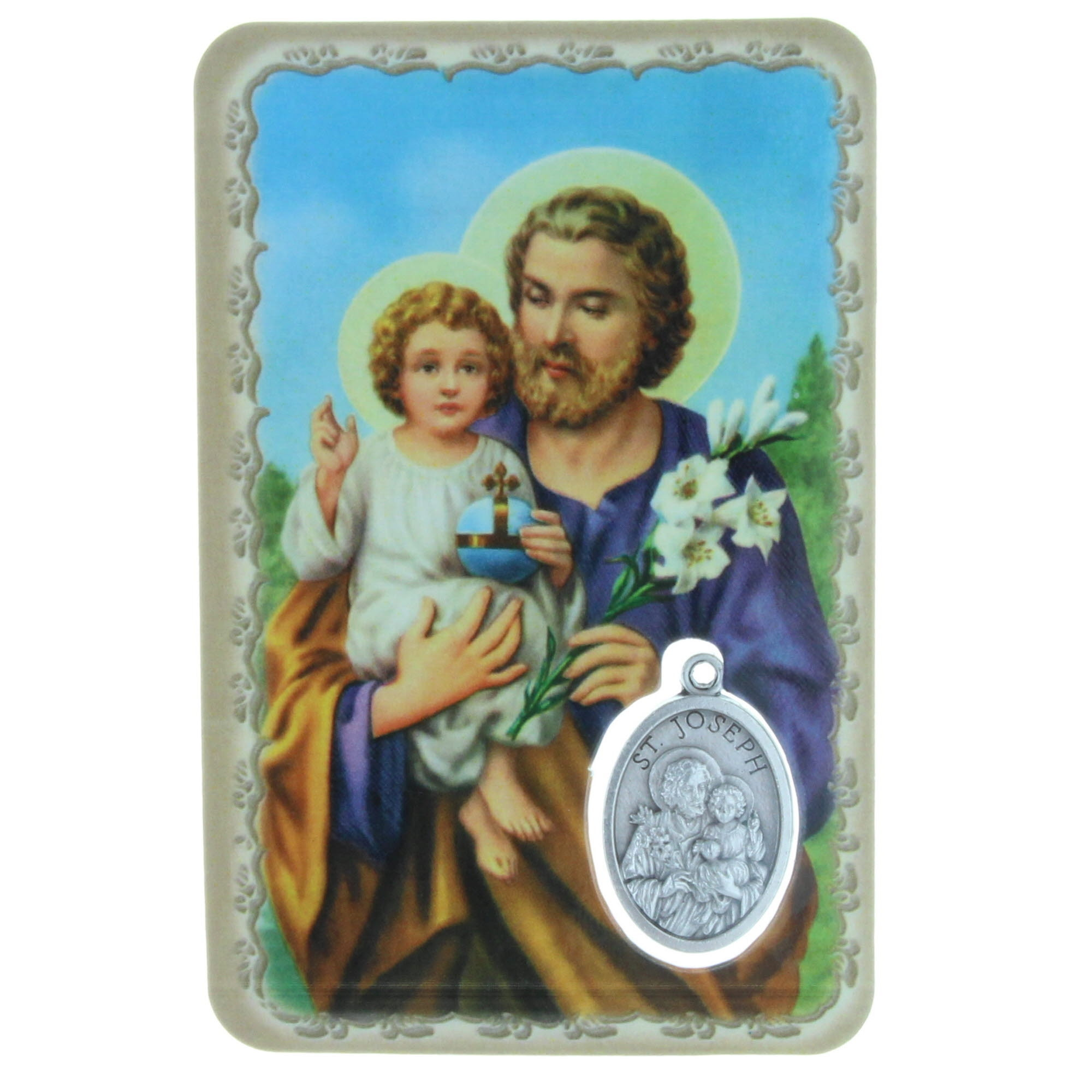
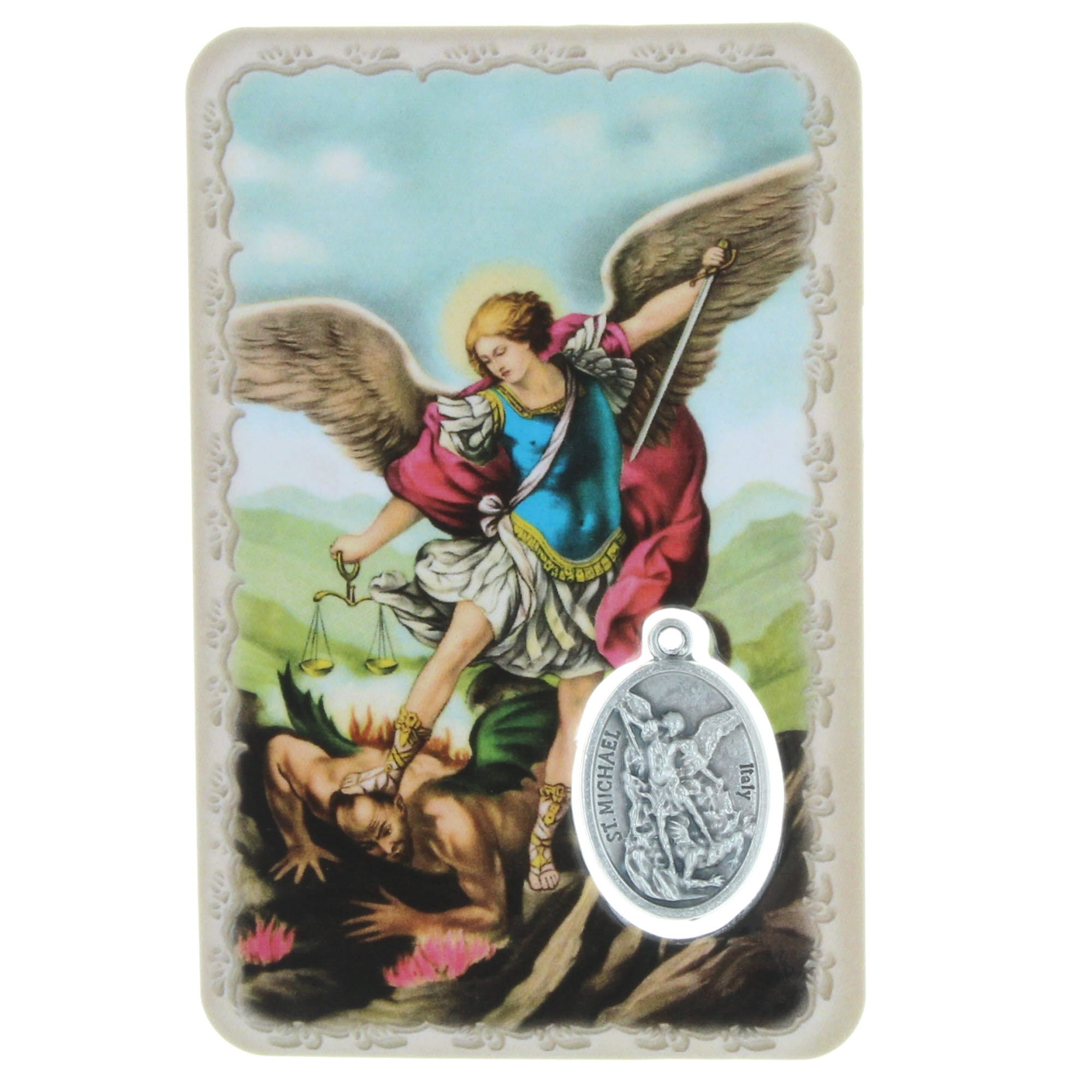
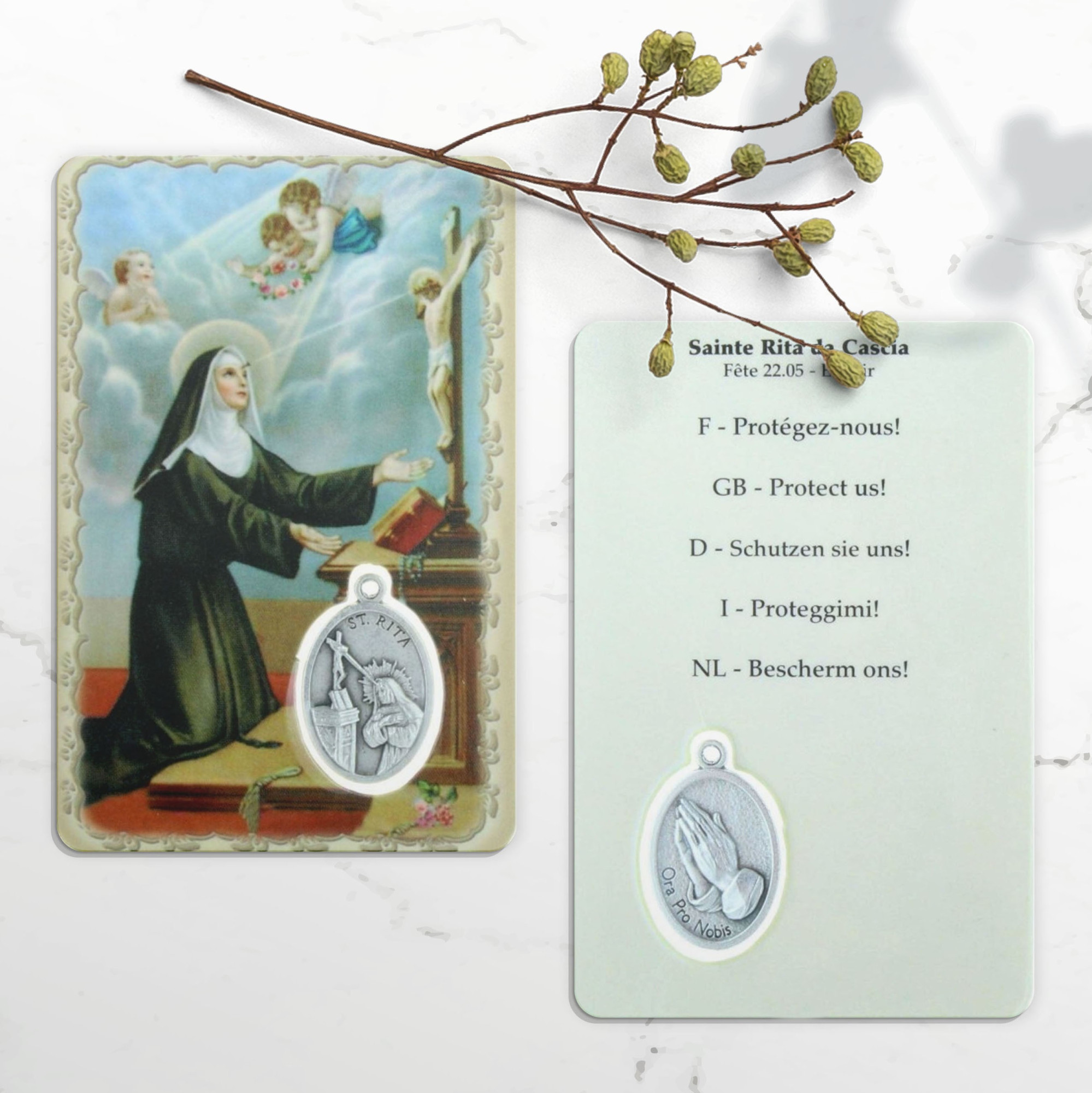
An image of Saint Rita, for example, can accompany the prayers of someone going through a trying time. An image of Saint Joseph can serve as a reminder of trust, work, family life and unassuming service. An image of Saint Michael the Archangel can inspire us to ask for courage and strength in the spiritual battle.
A connection with a patron saint
A patron saint is a saint chosen or recognised as the spiritual protector of a person, a profession, a community, a place or a particular situation. Many Catholics own an image of their patron saint or of the saint corresponding to their first name.
You can choose a religious image based on:
- your baptismal name;
- the first name of the person to whom the image will be given;
- your profession or vocation;
- a particular difficulty;
- a prayer intention;
- a saint whose life is a source of deep inspiration.
Such an image helps one to learn more about the saint’s life and to seek their intercession. It can also serve as a personal religious gift, particularly for a baptism, confirmation, First Communion or name day.
Discover religious items dedicated to patron saints.
A memento of a pilgrimage or a religious event
Religious images are often brought back from a pilgrimage or distributed at a shrine. They thus serve as a memento of a place, a celebration or a significant spiritual encounter.
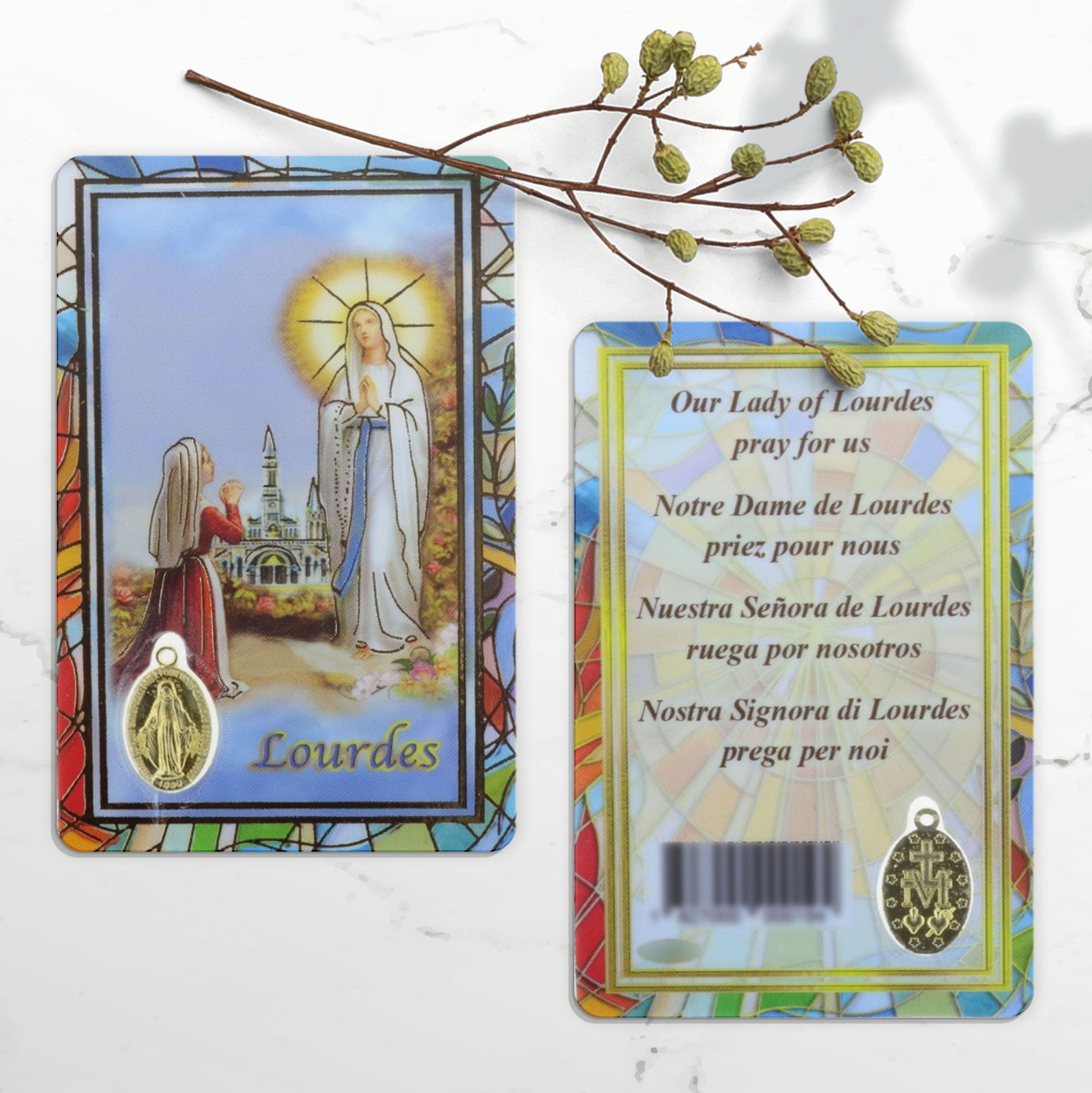
A religious image from Lourdes may depict Our Lady of Lourdes, Saint Bernadette or the Grotto of Massabielle. It serves as a reminder of the Marian apparitions at Lourdes and may accompany the prayers of someone who has made a pilgrimage or who is praying for a sick person.
The devotional image can also mark an important stage in a Christian’s life. When given on the occasion of a sacrament, it becomes a keepsake that can be treasured for many years.
A date, a first name or a short message may sometimes be added to commemorate the event being celebrated. The image thus combines three dimensions:
- a spiritual dimension, through prayer and the image itself;
- an emotional dimension, because it is given by a loved one;
- a commemorative dimension, because it recalls an important date or moment.
Simple, lightweight and accessible, a religious image can thus stand the test of time and remain linked to a precious memory of one’s life of faith.
Why have a religious image at home or on your person?
Owning a religious image allows you to keep a discreet sign of your faith close at hand and a tangible reminder to pray. Thanks to its small size, it can accompany your daily activities without taking up any space.
A devotional image can be placed:
- in a wallet;
- in a handbag or travel bag;
- in a pocket;
- inside a missal or prayer book;
- in a book, as a bookmark;
- on a bedside table;
- on a desk;
- in a prayer corner;
- in a car.
In a car, an image of Saint Christopher, Our Lady of Lourdes or another saint can remind the driver to take a moment to pray before setting off. However, it does not guarantee protection against accidents. Rather, it invites the driver to entrust their journey to God, to remain cautious and to drive responsibly.
Similarly, an image kept in a wallet or bag should not be regarded as a magical object. Its presence serves as a reminder of an intention, a prayer or a person to entrust to God.
Creating a point of reference in daily life
A day can be filled with work, family commitments, travel and worries. Amidst this sometimes hectic pace, a religious image provides a visual focal point. It can encourage you to pause, find some silence and say a short prayer.
Placed on a desk, it can serve as a reminder of a prayer intention throughout the day. On a bedside table, it can accompany morning or evening prayers. In a prayer corner, it can be placed alongside a Bible, a candle, a crucifix, a rosary or a religious statue.
It can also serve as a reminder of a loved one. An image given by a parent, grandparent, godparent or friend often holds deep sentimental value. Beyond the object itself, it bears witness to an intention to pray and a desire to pass on the faith.
Why give a religious image?
Giving a religious image is a simple and thoughtful way to convey a message of faith, hope and support. Affordable, lightweight and easy to keep, it can accompany many events in a Christian’s life.
A religious card can be chosen based on the saint depicted, the prayer written on the back, the sacrament being celebrated or the intention one wishes to entrust to God. It can be given on its own, slipped into a greeting card or paired with a medal, a rosary or another religious gift.
Giving a religious image as a christening gift
Christening marks the entry into Christian life. A religious image given on this occasion can serve as a reminder of God’s presence and accompany the child throughout their life of faith.
You can choose from:
- an image of Jesus welcoming children;
- an image of the Virgin Mary;
- an image of the Holy Spirit;
- an image of the Holy Family;
- an image of the child’s patron saint;
- a prayer card with a prayer suitable for a baptism.
The godfather or godmother can add a first name, a date or a short personal message on the back. The image then becomes a lasting memento of the celebration.
Giving an image as a First Communion gift
At a First Communion, an image of Christ, the Eucharist, a chalice or the consecrated bread can serve as a reminder of the meaning of the sacrament received.
An image of the Virgin Mary or the child’s patron saint may also be chosen. Kept in a missal or prayer book, it can accompany future celebrations and moments of reflection.
Giving an image as a gift for Confirmation
Confirmation is linked to the gift of the Holy Spirit and a personal commitment to the faith. A religious image depicting the Holy Spirit, a dove, the apostles or a patron saint makes a particularly fitting gift.
It can encourage the person being confirmed to seek the strength, wisdom and courage needed to live out their faith in daily life.
Giving a picture as a wedding or wedding anniversary gift
For a Christian wedding, a picture of the Holy Family, the Virgin Mary or Saint Joseph can serve as a reminder of the importance of fidelity, listening, service and prayer in married life.
St Joseph is particularly associated with family life, work and trust in God. An image dedicated to this saint can be given to the couple on their wedding day or to mark a wedding anniversary.
Discover religious items dedicated to Saint Joseph.
Giving an image as a gift for an ordination or religious profession
A priestly ordination or religious profession is a major moment in the life of a person called to serve God and the the Church. An image depicting Christ, the Good Shepherd, the Virgin Mary or the person’s patron saint can be given as a memento of this vocation.
A prayer for faithfulness, service, humility or perseverance can also lend special meaning to the gift.
Giving an image to someone who is ill or going through a difficult time
A religious image can be given with great sensitivity to someone who is ill, isolated, anxious or going through a difficult time. It expresses a sense of presence, a thought and a prayerful intention.
You could choose an image of Our Lady of Lourdes, Saint Rita, the Merciful Jesus or a saint to whom the person is particularly attached.
The message should remain gentle and respectful. The image promises neither automatic healing nor the end of suffering. It simply serves as a reminder that the person can entrust their fears, their suffering and their hope to God.
Discover religious items featuring Saint Rita and statues of Our Lady of Lourdes.
Giving a religious image at a funeral or in memory of the deceased
A religious image may be handed out at a funeral or given to the family in memory of the deceased. It sometimes includes a photograph, key dates from the person’s life and a prayer.
It provides a discreet way to preserve a memory and to express the Christian hope in eternal life. In this context, the tone must always remain understated, respectful and comforting.
An image of the Resurrection, of Christ, of the Virgin Mary or of a biblical passage can accompany the prayers of loved ones during the period of mourning.</ p>
What religious images can you discover at the Palais du Rosaire?
The Palais du Rosaire’s collection has been expanded to offer a wide range of depictions of Christ, the Virgin Mary, Lourdes and the saints. This variety allows everyone to choose an image according to their devotion, their prayer intention or the occasion they wish to mark.
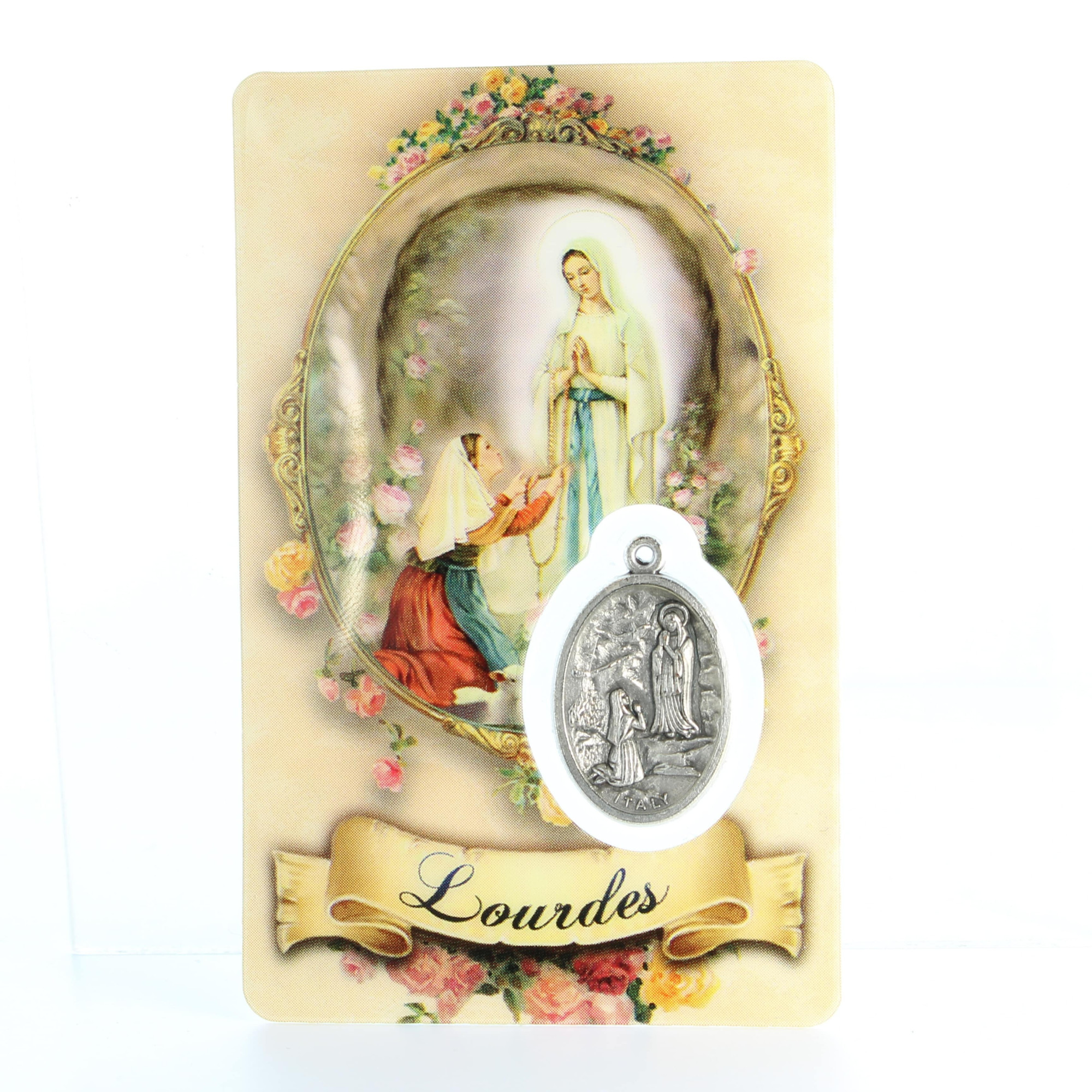
Images of Our Lady of Lourdes and Saint Bernadette
The images of Our Lady of Lourdes recall the apparitions of the Virgin Mary to Bernadette Soubirous at the Grotto of Massabielle. They often depict the Virgin dressed in white, with a blue sash, her hands clasped and a rosary draped over her arm.
A picture of Our Lady of Lourdes can be chosen as a souvenir of a pilgrimage, as a prayer card or as a thoughtful gift for someone who is ill or going through a difficult time.
Pictures of Saint Bernadette also help us to gain a better understanding of the testimony of this young girl from Lourdes, who was characterised by humility, simplicity and faithfulness.

Discover religious items dedicated to Saint Bernadette.
To extend this devotion to a prayer corner, you can also explore the statues of Our Lady of Lourdes.
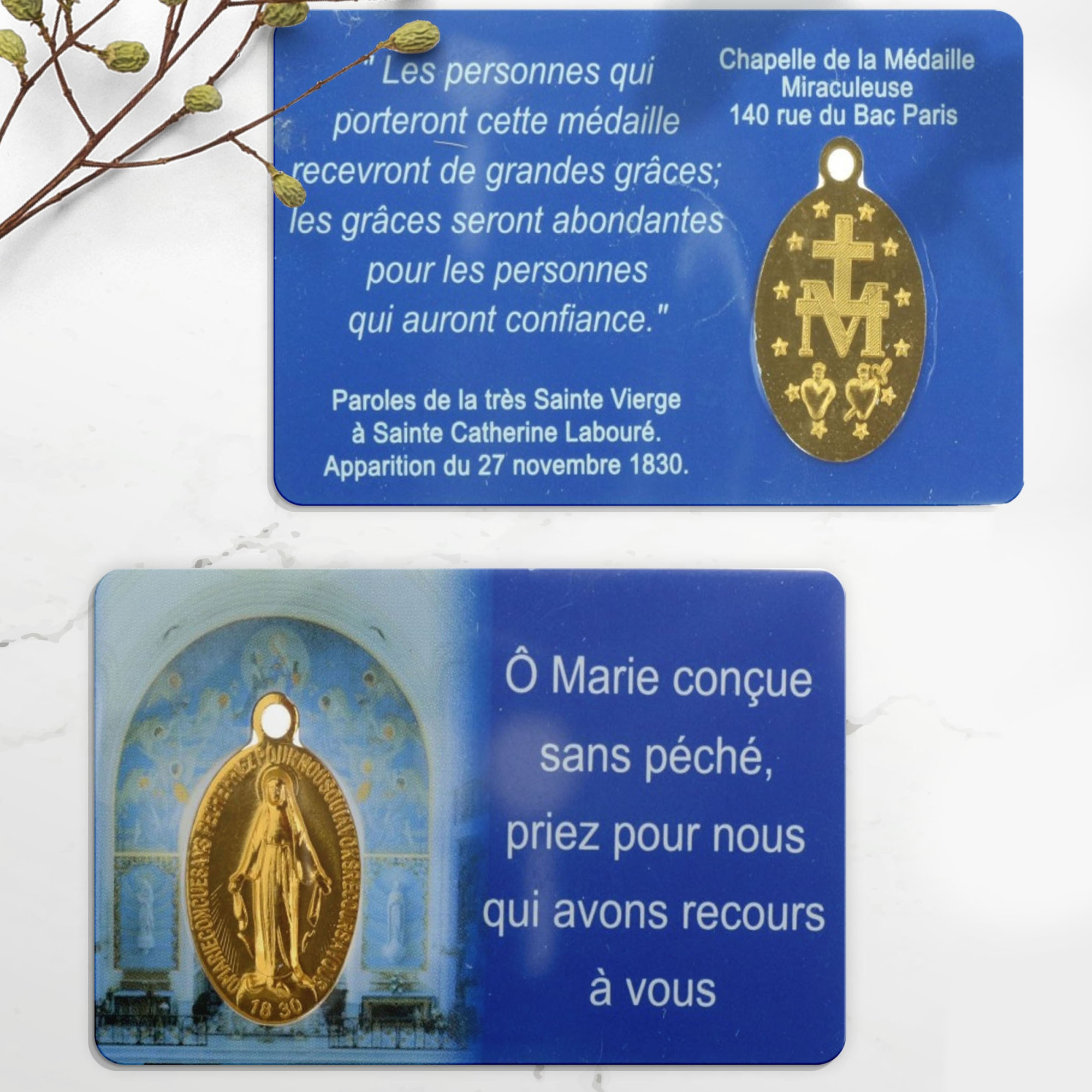
Images featuring the Miraculous Medal
The Miraculous Medal is linked to the Marian apparitions reported by Saint Catherine Labouré in Paris in 1830. It depicts the Virgin Mary and bears an invocation inviting the faithful to seek her intercession.
A religious image accompanied by a Miraculous Medal often combines a depiction of the Virgin Mary with a prayer. It can be given as a on the occasion of a sacrament, a pilgrimage or a particular intention.
The image and the medal remind the faithful that they can turn to Mary with confidence and ask her to intercede with God.
Discover the Miraculous Medals from the Palais du Rosaire.

Images of Saint Joseph
Saint Joseph is the husband of the Virgin Mary and the foster father of Jesus. The Gospels present him as a righteous man, attentive to God’s will and faithful to his mission.
An image of Saint Joseph can accompany a prayer for:
- the family;
- work;
- fathers;
- spouses;
- those seeking employment;
- those called to serve with discretion.
Discover images, medals and religious items dedicated to Saint Joseph.

Images of Saint Benedict
Saint Benedict is a major figure in Western monastic life. His spirituality places central importance on prayer, work, a balanced life and the search for God.
An image of Saint Benedict can accompany a prayer for inner peace, discernment and faithfulness in the spiritual struggle. It is sometimes offered alongside a Saint Benedict medal.
Discover religious items featuring Saint Benedict.

Images of Saint Rita
Many of the faithful turn to Saint Rita when they are going through a difficult situation or a trial that seems to have no way out. Her story is a reminder of perseverance in prayer, forgiveness and hope.
An image of Saint Rita can be given to someone going through a difficult time or kept to accompany a novena and a personal intention.
Discover images, medals and religious items featuring Saint Rita.

Images of Saint Michael the Archangel
In Christian tradition, Saint Michael the Archangel is presented as the defender of God’s people. He is often depicted fighting evil, armed with a sword or a spear.
An image of Saint Michael can accompany a prayer for courage, inner strength, discernment and spiritual protection.
Discover religious items dedicated to Saint Michael.

Images of patron saints
Images of patron saints allow everyone to find a representation linked to their first name, profession, vocation or a particular intention.
They are often given as gifts to mark a baptism, a confirmation, a name day, the start of a pilgrimage or an important milestone in one’s life.
Discover religious images and objects dedicated to patron saints as well as medals of saints.
How can you use a religious image to pray?
A religious image with a prayer can help you simply enter into a time of contemplation. There is no need to follow a complicated method: the main thing is to open yourself up inwardly and turn your heart towards God.
Here is a simple way to pray with a devotional image:
- Find a quiet place, as far as possible.
- Place the religious image in front of you.
- Slowly make the sign of the cross.
- Look at the image and reflect on the life of Christ, the Virgin Mary or the saint depicted on it.
- Read the prayer or invocation written on the back.
- Entrust a personal intention, a person or a situation to God.
- Remain silent for a few moments.
- Conclude with an Our Father, a Hail Mary or a prayer addressed to God, asking for the intercession of the saint depicted.
The image must not become the focus of the prayer. It serves as a point of support for reflection, avoid distractions and better direct one’s thoughts towards God.
Associating the religious image with a novena
An image of a saint can accompany a novena, that is to say, a prayer recited for nine consecutive days. The faithful may place the image in their prayer corner, read the suggested text each day and entrust the same intention faithfully.
An image of Saint Rita, Saint Joseph, Saint Benedict, Saint Michael or Our Lady of Lourdes can thus serve as a point of reference throughout the novena.
Praying the Rosary before a religious image
An image of the Virgin Mary may also accompany the recitation of the Rosary. By contemplating Our Lady of Lourdes, Our Lady of the Rosary or the Miraculous Medal, the faithful are invited to meditate on the mysteries of Christ’s life together with Mary.
The image and the rosary complement one another: the former draws the eye and aids meditation, whilst the latter gives rhythm to the prayer.
Complete your prayer corner with a rosary from the Palais du Rosaire.
Using an image for family prayer
In a family, a religious image can be placed near a Bible, a crucifix or a statue to create a simple space for prayer. Parents and children can gather there for a few minutes to give thanks to God, entrust their day to Him or pray for someone who is ill.
For younger children, the image helps them to recognise Jesus, the Virgin Mary and the saints. It makes prayer more tangible and can help to pass on the faith.
Keeping an image in a missal or a Bible
Thanks to its small size, a prayer card can be slipped into a missal, a Bible or a spiritual book. It can serve as a bookmark and remind you of a prayer whilst you are reading.
It is also possible to write down an intention, a first name or an important date on it. The image then becomes a personal reminder to be rediscovered as you read.
Religious image, medal or rosary: which to choose?
Religious images, medals and rosaries are different but complementary devotional objects. The choice depends on the intended use, the person for whom the gift is intended and how they wish to practise their faith.
| Religious object | Main use | For what occasion? | Advantage |
|---|---|---|---|
| Religious image | To pray, meditate, read a prayer or learn about the life of a saint | Baptism, First Communion, Confirmation, wedding, pilgrimage, as a token of support or a keepsake | Small size, easy to keep and give as a present |
| Religious medallion | To wear a symbol of faith representing Christ, the Virgin Mary or a saint | Baptism, First Communion, Confirmation, birthday or religious gift | A durable item that can be carried with you |
| Rosary | To recite the Rosary and meditate on the mysteries of Christ’s life | First Communion, Confirmation, pilgrimage or as part of a daily prayer routine | Supports a regular and structured prayer life |
When should you choose a religious image?
A religious image is particularly suitable when you wish to:
- keep a short prayer with you;
- give a simple and accessible religious keepsake;
- mark a sacrament or an event;
- learn about the life of a saint;
- place an image in a prayer corner;
- include a spiritual message in a card or a gift.
When should you choose a religious medal?
A medal is a good choice when someone wishes to wear a visible or discreet sign of their faith. It often depicts the Virgin Mary, Christ, a patron saint or a Christian symbol.
Worn around the neck, kept in a pocket or presented with a chain, it serves as a reminder of prayer and spiritual belonging. Like the image itself, it should not be regarded as a magical object.
Discover the religious pendants and medallions at the Palais du Rosaire.
When should you choose a rosary?
The rosary is particularly suitable for those who wish to recite the Rosary regularly, learn this prayer or deepen their devotion to Mary.
It can be given on its own or accompanied by an image of Our Lady of Lourdes, Our Lady of the Rosary or the Miraculous Medal.
Discover the Palais du Rosaire’s collection of rosaries.
Can these items be combined into a single religious gift?
An image, a medal and a rosary can certainly be combined into a single gift. This combination is particularly suitable for a baptism, a First Communion, a confirmation, a pilgrimage or a religious anniversary.
The image offers a prayer and a representation, the medal can be worn, and the rosary accompanies the recitation of the Rosary. Together, they form a cohesive, personal and lasting gift.
Religious images in 2026: a tradition that is still very much alive
In 2026, religious images remain deeply embedded in the lives of many of the faithful. Despite the rise of prayer apps, online spiritual content and digital media, the religious card retains a special value.
Their popularity can be attributed in particular to:
- their small size;
- their generally affordable price;
- the ease with which they can be carried and given as gifts;
- the frequent inclusion of a prayer on the reverse;
- the variety of saints and depictions;
- its spiritual and sentimental value;
- its connection with pilgrimages and the sacraments;
- the possibility of pairing it with a medal.
A religious image can be kept for many years. Some are passed down from one generation to the next and serve as a reminder of a baptism, a communion, a wedding or a pilgrimage to Lourdes. They thus become a testament to the family’s faith.
A place in wallets and prayer corners
Pocket-sized formats allow an image to be kept in a wallet, pencil case, bag or book. It can be consulted at any time to say a prayer or recall an intention.
At home, it naturally finds its place in a prayer corner, on a bedside table or next to a Bible. It helps to create a space conducive to silence and meditation, even in a small home.
A religious souvenir from Lourdes
Images depicting Our Lady of Lourdes, Saint Bernadette or the Massab remain particularly popular. They can be brought back from a pilgrimage or given as a gift to someone who is unable to visit the sanctuary themselves.
The Palais du Rosaire, thanks to its proximity to Lourdes, offers a selection of items to help preserve the memory of the pilgrimage and to accompany daily prayer.
A wide variety of images
Today, the faithful can choose from a wide range of images: Jesus Christ, the Virgin Mary, Our Lady of Lourdes, Saint Bernadette, Saint Joseph, Saint Benedict, Saint Rita, Saint Michael the Archangel and many other patron saints.
This variety makes it possible to select a card based on a first name, a profession, a devotion, an event or a prayer intention.
Images prized by collectors
Antique devotional images also appeal to certain collectors. They appreciate their graphic style, printing technique, paper lace, typography or the traces left by their history.
However, collecting is not the only purpose of these objects. Contemporary religious images remain, above all, living aids to prayer and the transmission of the faith.
The current collection at the Palais du Rosaire allows everyone to find an image suited to their devotion, their intention or the person they wish to support.
Prayer before a religious image
Lord my God,
Before this image, I take a moment of silence to turn towards You.
May this representation of Christ, the Virgin Mary or one of Your saints help me to open my heart to Your presence.
I entrust to You my joys, my worries, my plans and the people I love. You know what lies deepest within me, even when I cannot find the words to express it.
Grant me strength in times of trial, patience whilst I wait, and light when I no longer know which path to follow.
Through the example of the saint depicted in this image, teach me to move forward with faith, humility and trust. Help me to imitate his courage, his charity, his faithfulness and his love for You.
May this image be not merely an object I keep, but a daily reminder of Your love and an invitation to pray.
Watch over my family, the sick, those who are lonely, those who are bereaved and all those going through a difficult time.
Receive the intention I place before You today.
Take a few moments of silence to entrust your personal intention.
Lord, guide my steps, strengthen my faith and keep my heart at peace.
Amen.
Accompany your religious image with a rosary to create a genuine time of prayer.
FAQ on religious images
What is a religious image?
A religious image is a small card depicting Jesus Christ, the Virgin Mary, a saint, an angel or a biblical scene. It often features a prayer, an invocation or a spiritual text on the reverse.
What is the difference between a religious image and a devotional image?
The terms ‘religious image’ and ‘devotional image’ ’ are generally used to refer to the same type of devotional item. The term ‘prayer card’ may also be used when a prayer appears on the reverse.
What is a religious image used for?
It helps with prayer, meditation, remembering the life of Christ or a saint, and keeping a spiritual intention in mind. It can also mark a sacrament, a pilgrimage or an important event.
Can a religious image be given as a gift?
Yes. A religious image can be given as a gift for a baptism, First Communion, Confirmation, wedding, ordination, pilgrimage, or to offer support to someone who is ill, going through a difficult time or bereaved.
Where should a religious image be placed?
It can be placed in a wallet, a missal, a Bible, a book, a bedroom, a prayer corner, on a bedside table or in any place conducive to contemplation.
How do you choose a holy card?
The choice can be based on one’s first name, patron saint, profession, personal history or the prayer intention one wishes to entrust. It is also possible to choose a saint whose life inspires a particular virtue.
Can a religious image be accompanied by a medal?
Yes. Some images are available with a Miraculous Medal, a saint’s medal, a medal of Our Lady or a small religious pendant.
Does a religious image need to be blessed?
A religious image may be blessed by a priest, but this blessing is not required in order to use it as an aid to prayer. The blessing serves as a reminder that the the object is intended to support the believer’s spiritual life.
Does a religious image automatically offer protection?
No. In the Catholic faith, an image does not function as a talisman and does not guarantee freedom from accidents, illness or trials. It accompanies prayer and invites the faithful to place their trust in God.
Which religious image should one give as a First Communion gift?
For a First Communion, you could choose an image of Jesus Christ, the Eucharist, a chalice, the Virgin Mary or the child’s patron saint.
What religious image should you give to someone who is ill?
An image of Our Lady of Lourdes, Saint Rita, the Merciful Jesus or a saint particularly dear to the person can accompany a prayer intention and be a sign of loving support.
Choosing a religious image to support faith in daily life
Small in size but rich in meaning, the religious image has spanned the centuries whilst remaining thoroughly relevant today. It can help with prayer, pass on the faith, remind us of a saint’s life, preserve a memento of a pilgrimage or mark an important event.
Whether it depicts Jesus, the Virgin Mary, Our Lady of Lourdes, Saint Bernadette, Saint Joseph, Saint Benedict, Saint Rita, Saint Michael or a patron saint, it always invites the faithful to turn their hearts towards God.
Chosen to reflect a particular intention, a sacrament or the person for whom it is intended, it makes for a simple, accessible and enduring religious gift. Designs accompanied by a medal also allow several signs of devotion to be combined in a single gift.
 Preparations for Pope Leo XIV’s visit to Lourdes in 2026
  Torchlight Procession in Lourdes - A moment of Prayer and Light
  The Popes at Lourdes: from John Paul II to Leo XIV’s visit in 2026
  Biblical first names: meanings and ideas for girls and boys in 2026
  What is the Assumption?
How do you choose a religious image?
The choice of a religious image may depend on several criteria: the person depicted, the intention of the prayer, the event being commemorated, the recipient, or even the inclusion of a medal.
There is no single rule. The key is to choose an image that holds meaning for the person who will keep it, or that reflects the spiritual message you wish to convey.
Choose according to the person depicted
The first criterion is to choose a religious figure to whom the believer feels a connection, or whose life story aligns with their intention.
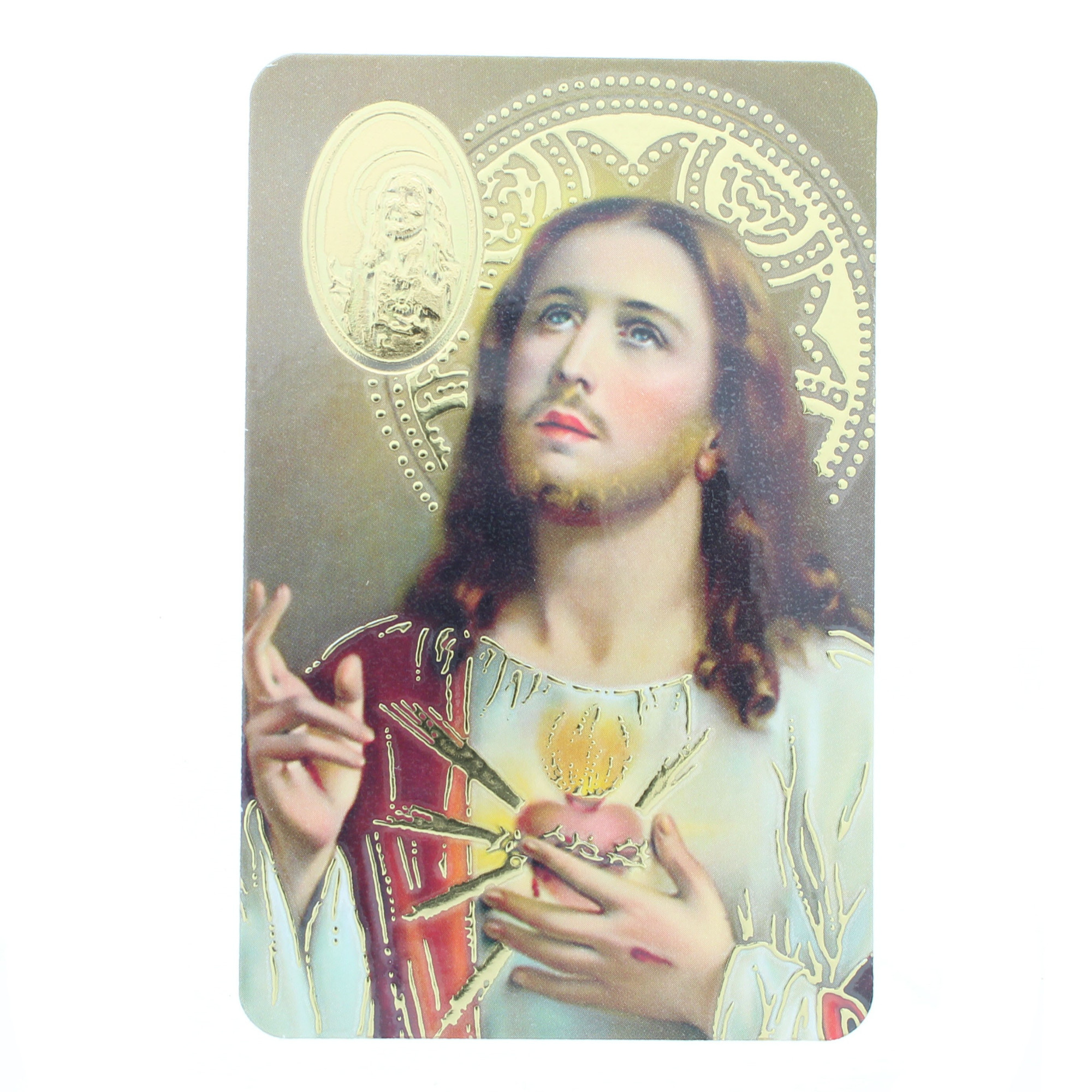
An image of Jesus Christ
An image of Jesus may be chosen to reflect on his teachings, his Passion, his Resurrection, his mercy or his love for humanity. It is suitable for many occasions, including a baptism, a First Communion, a Confirmation or a time of trial.
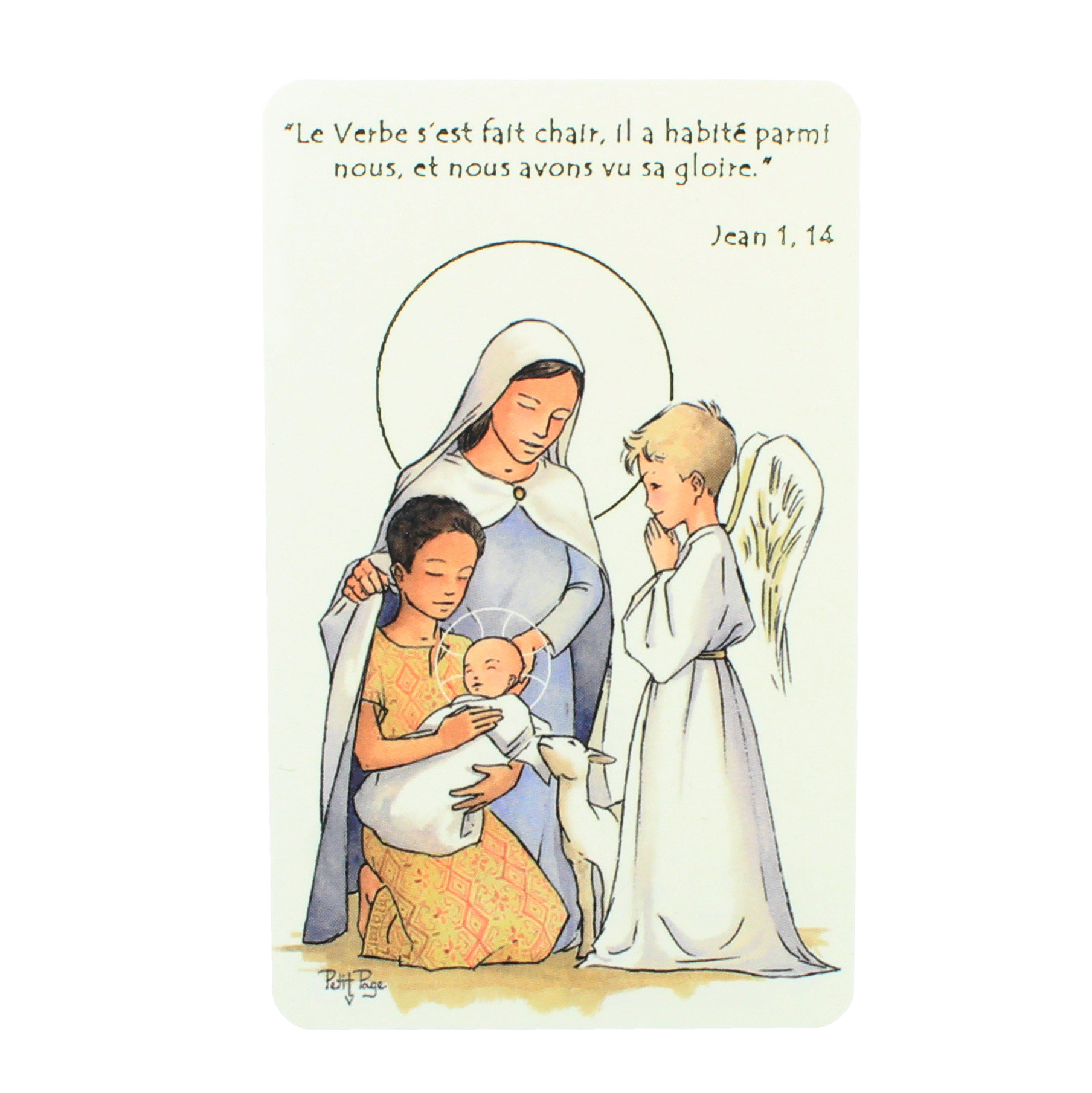
An image of the Virgin Mary
The Virgin Mary is often depicted under various titles: Our Lady of Lourdes, Our Lady of the Miraculous Medal, Our Lady of the Rosary or the Immaculate Heart of Mary.
An image of the Virgin Mary</ strong> can accompany a prayer for the family, trust, peace, motherhood or consolation.
An image of Our Lady of Lourdes or Saint Bernadette
An image of Our Lady of Lourdes recalls the apparitions to Saint Bernadette and the special place Lourdes holds in the prayers of pilgrims. It can be kept as a religious memento of Lourdes or given to someone who is ill, to a family, or to a loved one in need of comfort.
An image of Saint Joseph
As the husband of the Virgin Mary and foster father of Jesus, Saint Joseph is a model of trust, humility, hard work and fidelity. His image is often chosen for prayers for the family, work, fathers or those seeking employment.
An image of Saint Benedict
Saint Benedict holds an important place in Christian tradition. His image and medal are often associated with prayer, inner peace and spiritual protection.
An image of Saint Benedict serves as a reminder that true Christian protection is rooted in faith, prayer and trust in God, and not in any automatic power attributed to the object itself.
Discover religious items dedicated to Saint Benedict.
An image of Saint Rita
Saint Rita is particularly invoked by those facing difficult, protracted or emotionally complex situations. Her image can accompany a prayer for perseverance, reconciliation and hope.
Discover religious items dedicated to Saint Rita.
An image of Saint Michael the Archangel
In Christian tradition, Saint Michael is depicted as the one who fights evil and remains faithful to God. An image of Saint Michael can accompany a prayer for courage, discernment and spiritual protection.
Discover religious items dedicated to Saint Michael.
An image of a patron saint
Choosing an image of a patron saint helps to create a personal connection between the devotee and the saint depicted. The choice may be linked to a first name, a profession, a life situation or a particular devotion.
Choose an image or a religious object dedicated to your patron saint.
Choose according to your prayer intention
A religious image can also be selected according to the intention one wishes to entrust to the saint. This approach helps you find a representation and a prayer suited to your current circumstances.
For example:
Choosing an image does not guarantee the desired outcome. It helps one to formulate an intention, to persevere in prayer and to entrust a situation into God’s hands.
Choose according to the person for whom the image is intended
When an image is given as a gift, it is helpful to take into account the recipient’s age, background and sensibilities.
For a child, a gentle and easily understandable image may be preferable. For a teenager receiving Confirmation, an image of the Holy Spirit or their patron saint may give the gift greater meaning.
For an elderly person, an image of Our Lady of Lourdes, the Sacred Heart of Jesus or a saint to whom they are particularly attached may be especially appreciated. For someone discovering the faith, a card featuring a simple and accessible prayer will often be more suitable.
Choosing an image with or without a medal
Religious images come in a variety of forms. Some are sold on their own, whilst others come with a small medal attached to the card or included in its packaging.
A religious image with a medal combines two complementary devotional items:
Depending on the design, the image may be accompanied by:
The medal should not be regarded as a talisman. It is a visible sign of faith and serves as a reminder of the person depicted, a prayer or a spiritual commitment.</ p>
Discover our Miraculous Medals, our saints’ medals and our religious pendants and medals.