 Français
 Italiano
 English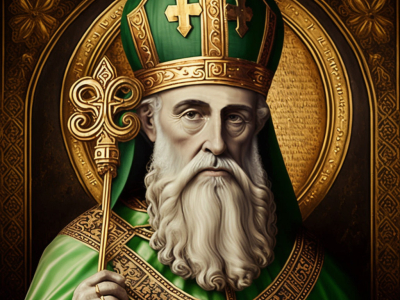

Every year on 17 March, millions of people around the world celebrate Saint Patrick's Day, a festival in honour of the patron saint of Ireland. But who really was Saint Patrick, and why is he so revered? Discover his fascinating story, his religious impact, the traditions associated with him and how to keep his memory alive with devotional objects.
Who was Saint Patrick?
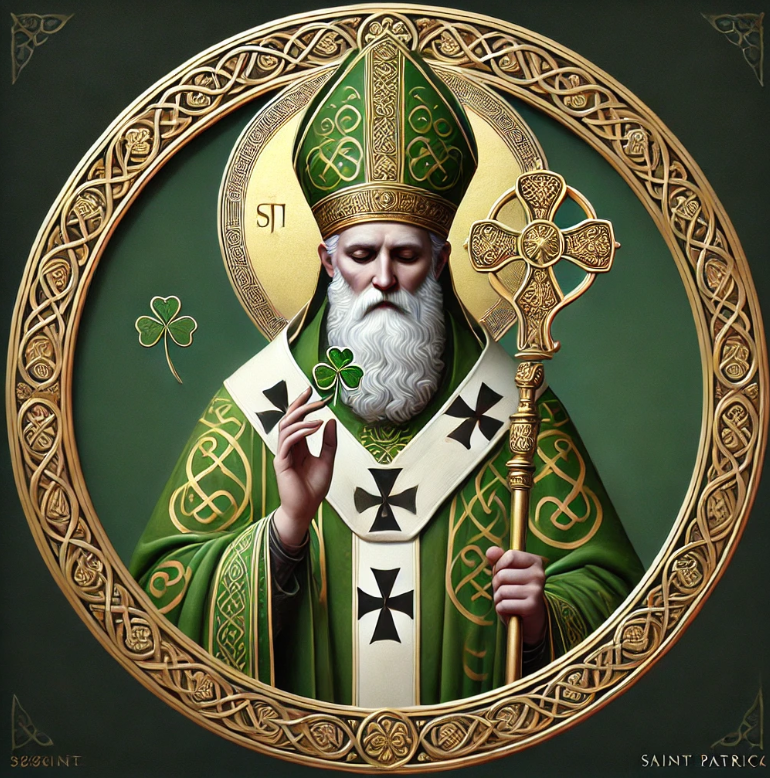
Saint Patrick was born around the year 385 in Great Britain, then under Roman rule, under the name Maewyn Succat. Born into a Christian family, he was kidnapped at the age of 16 by Irish pirates and sold into slavery in Ireland. For six years, he worked as a shepherd and found comfort in prayer. According to legend, he received a divine vision telling him how to escape. He managed to flee and returned to Great Britain.
After becoming a priest and then a bishop, he decided to return to Ireland to evangelise his former captors. He devoted his life to the conversion of the Celtic peoples and the establishment of Christianity in Ireland.
The evangelisation of Ireland
Saint Patrick's mission in Ireland was marked by many challenges. The country was pagan at the time, with a religious system based on Druidism. Patrick used simple teaching methods to explain the Christian faith, notably by using clover to illustrate the Holy Trinity (Father, Son and Holy Spirit).
He founded numerous churches, schools and monasteries, helping to make Ireland a major spiritual centre. It is said that he also drove the snakes out of Ireland, although this was probably a metaphor for his fight against paganism.

The symbols of Saint Patrick's Day
- The shamrock: The emblem of Ireland, it symbolises the Christian Trinity.
- The colour green: Associated with Ireland and spiritual renewal.
- Celtic crosses: Represent the fusion of Christianity with local traditions.
- Parades: imported by Irish immigrants to the United States, they are now an essential part of the festivities.
How do you honour Saint Patrick?
To express your devotion to Saint Patrick, you can pray and use religious objects bearing his image:
- A Saint Patrick rosary for saying your prayers.
- A statue of Saint Patrick to adorn your home.
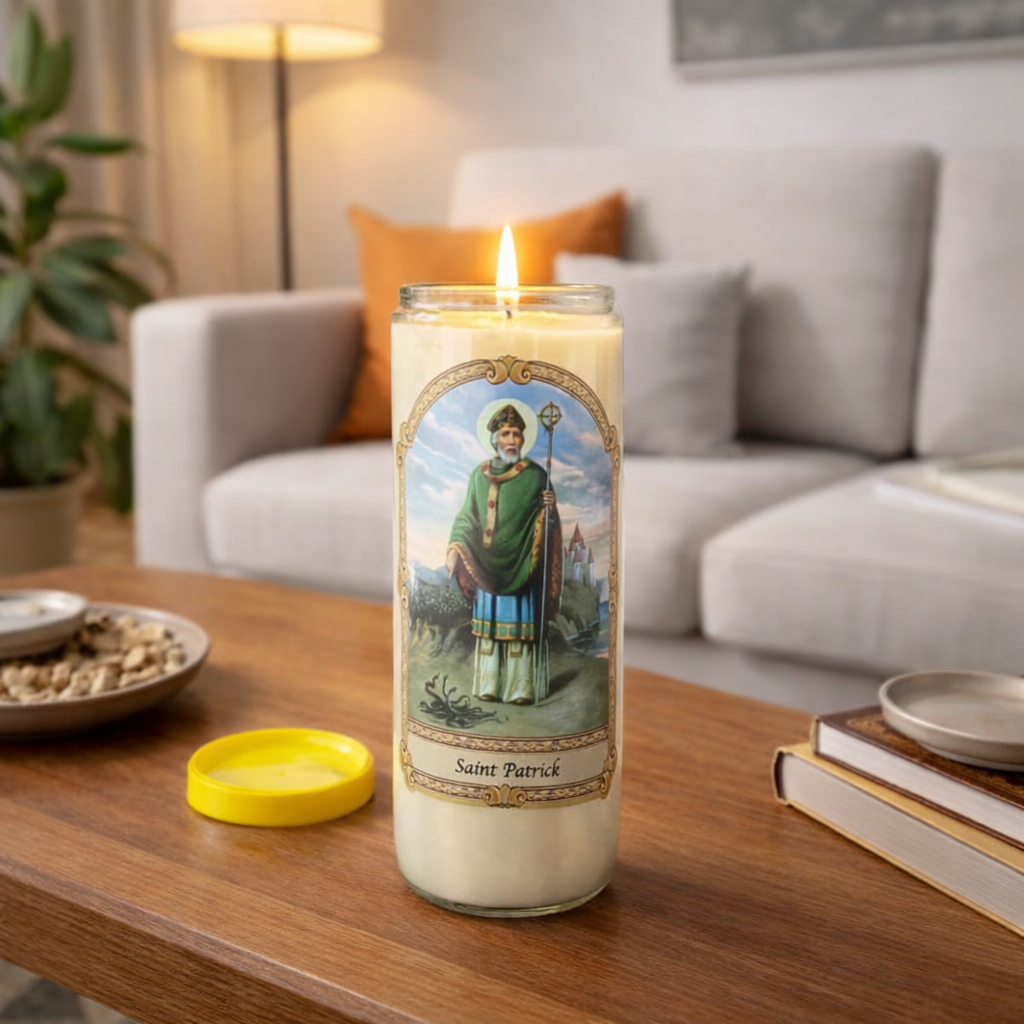
- A St Patrick novena candle to accompany your prayers.
St Patrick's traditions
St Patrick's Day is much more than a religious festival; it is also a cultural celebration characterised by several traditions:
- The big parades: From Dublin to New York, these parades attract thousands of spectators.
- Wearing green: In Ireland and elsewhere, it is customary to dress in green or risk being pinched!
- Traditional meals: Irish stew, soda bread and lamb dishes are often eaten.
Prayer to Saint Patrick
Saint Patrick, protector of Ireland and guide of souls, we pray to you fervently today.
O blessed Saint Patrick, you who brought the light of Christ to Celtic lands, watch over us and intercede with the Lord. Protect us from trials and guide our steps on the path of faith. By your strength and wisdom, teach us love and charity.
You who faced darkness and triumphed over doubt, grant us the strength to persevere. May your courage and humility inspire us every day. Bless our homes and our families, protect souls in search of light, and grant peace to those who suffer.
We entrust to you our hearts, our hopes and our sorrows. Fill us with divine grace and guide us towards holiness. Saint Patrick, apostle of souls, enlighten our path and intercede for us with the Lord.
Amen.
FAQ
Why do we celebrate St Patrick's Day?
St Patrick's Day is celebrated in honour of St Patrick, who evangelised Ireland and became its patron saint.
What are the symbols of Saint Patrick's Day?
The best-known symbols are the shamrock, the colour green and the Celtic harp.
How do you pray to Saint Patrick?
One can pray to Saint Patrick by reciting a special prayer and lighting a novena candle bearing his image.
What is the origin of the shamrock as a symbol of Saint Patrick's Day?
The shamrock was used by Saint Patrick to explain the Christian Trinity to the pagan Irish.
Which countries celebrate St Patrick's Day?
St Patrick's Day is mainly celebrated in Ireland, the United States, Australia and Canada.
Why do we wear green on St Patrick's Day?
People wear green on St Patrick's Day in homage to Ireland, nicknamed the ‘Emerald Isle’, and in reference to the shamrock that St Patrick used to explain the Trinity. The colour green is also associated with renewal and good luck.
 Preparations for Pope Leo XIV’s visit to Lourdes in 2026
  Torchlight Procession in Lourdes - A moment of Prayer and Light
  The Popes at Lourdes: from John Paul II to Leo XIV’s visit in 2026
  Biblical first names: meanings and ideas for girls and boys in 2026
  What is the Assumption?