 Français
 Italiano
 English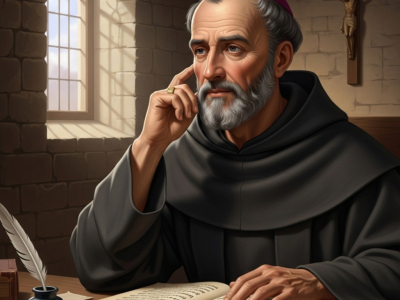

Saint-Augustine, celebrated every year on 28 August, is one of Christianity's greatest thinkers and spiritual figures. A Doctor of the Church, philosopher and theologian, he left behind an immense body of work and an indelible mark on Christian tradition. His spiritual and intellectual quest continues to inspire believers around the world.
In this article, you will discover the life of Saint-Augustine, his spiritual legacy, a dedicated prayer and an FAQ answering all your questions about this essential saint.
The Life of Saint-Augustine
1. A turbulent youth
Saint-Augustine was born on 13 November 354 in Thagaste, a city in Numidia located in present-day Algeria. The son of Patricius, an authoritarian pagan, and Saint Monica, a devout and loving Christian, he grew up in a home marked by conflicting influences. From an early age, he showed a lively mind, a keen interest in learning and remarkable eloquence. He was sent to Carthage to study rhetoric, a subject that fascinated him.
But this period of his youth was also marked by worldly pleasures. He devoted himself to a dissolute life, multiplying relationships and living according to his desires. At the age of 17, he became involved with a woman with whom he had a son, Adeodatus. Despite his brilliant intelligence, Saint-Augustine felt empty inside. He sought to understand the world, God, and himself through various philosophies, but never found peace.
He then embraced Manichaeism, a dualistic doctrine that promised clear answers about good and evil. But after several years, he realised the inconsistency of this thinking and began to detach himself from it. Meanwhile, his mother, Saint Monica, prayed fervently for his conversion. Her patience, love and unshakeable faith accompanied her son throughout his life like a discreet but decisive light.
2. Encounter with faith
In search of truth, Saint-Augustine went to teach in Milan, where he met Bishop Saint Ambrose. This was a major turning point. He admired Ambrose's eloquence, but above all, he discovered a profound, intelligent Christianity rooted in Scripture. Far from the caricatures he had previously held, he saw a faith that could satisfy both the mind and the heart.
Despite an intense inner struggle, he continued to resist conversion, torn between his spiritual aspirations and his worldly attachments. His account in The Confessions, one of his most famous books, powerfully describes this inner battle.
The key moment came in a garden in Milan in 386. Tormented and in tears, he heard a child's voice singing: ‘Tolle, lege’ – ‘Take and read’. He then opened the Bible and came across a passage from the Epistle to the Romans calling on him to renounce the works of the flesh. This was the moment of his conversion. He then decided to be baptised by Saint Ambrose on Easter night in 387, together with his son Adeodatus.
This moment marked a complete break with his past life. He renounced his public career, returned to Africa, founded a community and devoted himself entirely to God.
3. Bishop and Doctor of the Church
Back in Africa, Saint-Augustine was ordained a priest and then became Bishop of Hippo (now Annaba, Algeria) in 395. For more than 30 years, he exercised an intense pastoral ministry, preaching, teaching and writing tirelessly. He founded a monastery to live a communal life with his brothers in prayer and study.
His pastoral mission was coupled with an intellectual battle against the great heresies of his time: Manichaeism, which he himself had practised, Donatism, which divided the African Church, and Pelagianism, which denied the necessity of grace.
He wrote numerous works, including:
- The Confessions: a moving spiritual autobiography, written in the form of a prayer.
- The City of God: a masterful reflection on human history, the Church and Christian hope.
- On the Trinity, On Christian Doctrine, On Free Will: profound treatises on God, faith and man.
Saint-Augustine died on 28 August 430, while the city of Hippo was under siege by the Vandals. His body was transferred to Sardinia, then to Italy, where it now rests in Pavia.
His death marked the end of an era, but his legacy continued to grow. A Doctor of the Church, he remains one of the most luminous figures in Christian tradition.
 (14).png)
The Spiritual Legacy of Saint-Augustine
The thinking of Saint-Augustine marks a turning point in the history of Christianity. His influence extends throughout the Western tradition, both Catholic and Protestant. A theologian, philosopher, mystic and pastor, he was able to combine intellectual rigour and spiritual depth in a single work.
At the heart of his theology lies the fundamental notion of grace. For Saint-Augustine, man cannot save himself by his own efforts. Marked by original sin, they need to be regenerated by divine grace. This grace is not simply a helping hand, but a profound transformation of the heart, a free gift from God that lifts the soul up to Him.
Augustinian doctrine of salvation is based on this tension between human freedom and divine intervention. Man is free to choose, but only grace can enable him to truly choose good. This vision had a considerable impact on medieval theology, but also on modern reflections on freedom and predestination.
In parallel with this theological reflection, Saint-Augustine gave central importance to the inner quest. For him, God dwells in the innermost depths of the human soul. It is not by fleeing into external things that we encounter God, but by entering into ourselves: ‘You were within me, and I was outside myself,’ he wrote in the Confessions.
Prayer, contemplation and examination of conscience are at the heart of spiritual life according to Saint-Augustine. He was one of the first to describe the relationship with God as a dialogue of love, made up of silence, listening and trust. Here is one of his most famous quotes, often meditated upon by the faithful:
" You have made us for Yourself, Lord, and our hearts are restless until they rest in You."
In this, Saint-Augustine is a timeless spiritual guide, speaking as much to modern man in search of meaning as to the believer who desires to unite more intimately with God.
The great works of Saint-Augustine
The intellectual wealth of Saint-Augustine is based on a monumental body of work that is at once theological, philosophical and autobiographical. His writings are an essential source for understanding the foundations of Christian thought.
The Confessions is probably his most famous work. In this deeply moving book, he recounts his life, his wanderings, his conversion and his growing love for God. It is not simply an autobiography, but a living prayer, addressed directly to God, in which he exposes with rare sincerity the struggles of the human soul.
The City of God is another major work. Written after the sack of Rome in 410, it contrasts the City of God, formed by souls turned towards God, with the earthly city, centred on self-love. This monumental book is a pillar of Western political and theological thought.
Among his other important works are:
- On the Trinity: a profound meditation on the mystery of the triune God
- Sermons and pastoral letters that testify to his love for the Church
- Treatises against the heresies of his time (Manichaeism, Donatism, Pelagianism)
Through all these works, Saint-Augustine shows that faith is not opposed to reason, but that reason can be illuminated by faith: ‘Understand in order to believe, believe in order to understand.’
Reading Saint-Augustine means embarking on a demanding but enlightening journey, where reflection, love and faith intertwine in the service of Truth.
 (15).png)
A prayer to Saint-Augustine
O Saint-Augustine, tireless seeker of truth, you who have passed through the darkness of doubt, enlighten our hearts today with the light of your wisdom.
You who knew the seductions of the world, the passions of youth and the illusions of glory, teach us not to be distracted by passing vanities, but to desire what does not pass away.
Saint-Augustine, beloved son of Saint Monica, intercede for all mothers who weep for their children who are far from God. May your example and that of your mother rekindle hope in wounded or divided families.
You who once heard the call, ‘Take and read,’ make our hearts attentive to the Word of God. Give us a thirst to read the Scriptures, to meditate on them with understanding, and to live them with love.
O Doctor of Grace, help us to understand that it is not by our merits but by divine mercy that we are saved. Help us to abandon ourselves with confidence into the hands of the Father.
Inspire our generation with a love of truth, the beauty of humility, and the strength of faith. Obtain for us a spirit of prayer, contemplation, and inner silence, so that we may recognise God's presence in the depths of our souls.
Saint-Augustine, watch over the Church and all those who serve her. May pastors, following your example, be men of prayer, word and wisdom, faithful to the mission entrusted to them by Christ.
We entrust to you our doubts, our struggles, our wounds, our hopes. Lead us, as you were led, from the paths of error to those of light. May we say, with you, at the end of our journey:
‘Lord, late have I loved you, beauty so ancient and so new, late have I loved you. You were within me and I was outside myself...’
Saint-Augustine, pray for us. Amen.
Frequently asked questions
What is Saint-Augustine's most famous quote?
‘You have made us for Yourself, Lord, and our hearts are restless until they rest in You.’ is his most famous quote.
Why is Saint-Augustine famous?
Saint-Augustine is famous for his Confessions, his remarkable conversion, and his fundamental role in Christian theology.
What is Saint-Augustine's doctrine?
His doctrine is based on divine grace, human freedom, and the primacy of God's love.
What is the miracle of Saint-Augustine?
St Augustine's greatest ‘miracle’ is his own radical conversion, which marked the history of the Church.
Conclusion
Saint-Augustine is a leading figure for all believers. His unique journey shows that faith can spring from both the intellect and the heart. His life, writings and spiritual legacy continue to nourish the reflection and prayer of millions of faithful.
On Palais du Rosaire, find religious items inspired by the faith of saints such as Saint-Augustine. Offer a medal, rosary or icon to rekindle your faith or that of your loved ones.
 Preparations for Pope Leo XIV’s visit to Lourdes in 2026
  Torchlight Procession in Lourdes - A moment of Prayer and Light
  The Popes at Lourdes: from John Paul II to Leo XIV’s visit in 2026
  Biblical first names: meanings and ideas for girls and boys in 2026
  What is the Assumption?